Friday, September 14, 2018

The Battles of Lexington and Concord


A brief overview with recommendations for further reading at the end. Suggestions for wargames will follow in subsequent posts.

Dissent, discontent, unrest had been growing in the Thirteen American Colonies of Great Britain, at least in earnest, since the close of hostilities in the French and Indian War in 1763. The chief driving force was various attempts by the Mother Country to impose levies on the colonies to help defray the costs associated with defending them – be it from the French and Spanish, or from the natives who were being steadily pushed out of their own lands by the Europeans.

This discontent finally boiled over into actual armed conflict on April 19, 1775 when a British column was ordered out of Boston in an attempt to seize the two rebel (or Patriot, depending on your point of view) leaders John Hancock and Samuel Adams, who were in Lexington, Massachusetts, and a stash of arms and gunpowder that the rebels has established in Concord, Massachusetts.

The British military governor, General Thomas Gage ordered Lieutenant Colonel Francis Smith to take ten light infantry companies under Major John  Pitcairn (320 men, being the companies from the 4th, 5th, 10th, 23rd, 38th, 43rd, 47th, 52nd, and 59th Regiments of Foot and the Marine Battalion) and 11 grenadier companies under Lieutenant Colonel Benjamin Bernard (350 men, being the companies of the 4th, 5th, 10th, 18th, 23rd, 38th, 43rd, 47th, 52nd, and 59th Regiments of Foot and the Marine Battalion).

The British expedition was characterized by haphazard management from the beginning. The rebels knew of Smith’s destination before he did. Despite Gage sending out a patrol to keep the alarm from being given, rebel messengers (Charles Dawes and Paul Revere) were well on their way before the patrol could stop them. Although the troops were awakened at 9pm on the 18th for their expedition, the operation of loading their naval barges to cross the Charles River from Boston Common to Lechmere Point in Cambridge was poorly organized and they did not set off on their march until 2am, wet from disembarking in waist-deep water.

It was clear to the British, as they marched through Menotomy (now Arlington), only an hour from setting out, that the alarm had been raised. At 3 am Smith ordered Pitcairn to lead a flying column of 6 light infantry companies on ahead. An hour later, he sent a messenger back to Boston asking for reinforcements.

At Lexington the local “training band” or militia had gathered on the town green, about 80 men under the command of Captain John Parker. Parker apparently desired only to give a show of resistance, of disapproval, but did not intend to fight. The militia were assembled in plain sight and not in combat formation. They did not block the road to Concord, which, Parker knew, was the British goal.
Due to miscommunication, and apprehension however, the British column confronted the militia. 

About 5 am the lead three companies under Marine Lieutenant Jesse Adair arrived in Lexington, and, instead of marching past the militia, turned to face them. Pitcairn deployed the trailing three companies in support and ordered the militia to disperse. By mot accounts they had begun to do just that when a shot rang out. One of the mysteries is who fired it, but the result was the British let loose volley without orders and then charged the militia with bayonets. Only with some difficulty did the British officer regain control. The surviving militia dispersed.

At least two militiamen fired back in the confusion but the “battle” was over in only a few minutes. Eight militiamen were killed and ten wounded. Only a single British soldier was lightly wounded.
The British continued their march until about 1.5 miles from Concord when they encountered the assembled militias of Lincoln and Concord. Colonel James Barrett, however, knowing of the fight at Lexington and the size of the British column, prudently withdrew at a safe distance, back through Concord and over the North Bridge to a hill about a mile north of the town.

More militia continued to arrive, swelling to about 400. Meanwhile Smith had split his command into small parties to carry out Gage’s orders and find the munitions and supplies the rebels had secreted away. They did manage to find three massive 24-pounder cannon, 550 pounds of musket balls, nearly a hundred barrels of flour and salted pork, and several gun carriages. They broke the trunnions of the cannon, making them unusable, threw the musket balls and foodstuffs into the mill pond and burned the gun carriages.

Unfortunately, the burning gun carriages set alight the meetinghouse. Local citizens convinced the British to help with a bucket brigade to save the building. However, Barrett, seeing the smoke rising from the village, decided to advance on the small detachment guarding the North Bridge, about 100 light infantrymen commanded by Captain Walter Laurie.

The militia advanced in column, the Concord River being swollen by the spring rains. Captain Laurie then ordered his men to form column for street firing. A few random shots rang out, probably shots trying to alert their brethren in the village that they needed help. Then a ragged volley, still without orders to fire. Two militiamen, at the head of the column fell dead at this volley and, as the British continued to fire, at least four more fell. Major John Buttrick, leading the advance, ordered the militia to fire.

This volley cut into the disorganized British with devastating effect as half of the British officers and NCOs were hit and at least 12 privates. The British broke and ran, abandoning their wounded. Stunned at their success, the militia split into two defensive positions. Barrett led one group back to the hill to the north of the river while Major Buttrick occupied another hill across the river and up from the road.

Smith now recalled his various search parties, gave his men lunch, and started back to Boston about noon. Materially the only effect of his raid was to destroy the cannon and the gun carriages. The rebels later recovered most of the food and musket balls unharmed from the mill pond.

The militia from all the surrounding towns were now converging on the road back to Boston. From the moment the British column set out the militia had taken random ineffectual shots at the retreating column. But, at Meriam’s Corner, a crossroads about a mile east of Concord, the British rear guard turned to offer a volley. The militia, now closer, replied. No rebels were hit but the first British casualties of the retreat fell – two killed and six more wounded.

Another mile on, at Brooks’ Hill, Smith sent his lead companies up the hill to chase away the militiamen. The regulars were met by determined fire and were forced to withdraw. At one choke point after another the British were caught by the militias. At each point the British light infantry would try to push the militia away from the line of march. Sometimes the rebels would fall back, other times it would be the regulars. At the boundary of Lincoln and Lexington, Lt. Col. Smith was hit in the thigh and unhorsed. A bit later Major Pitcairn’s horse bolted, throwing him to the ground and injuring his arm.

By 2:30 only one British officer was uninjured. The column was saved from complete destruction by the arrival of a relief column of 1,000 men (the line companies of the 4th, 23rd, and 47th Regiments of Foot and the Marine Battalion) under the command of Brigadier General Hugh, Earl Percy. The relief column had been formed when Smith’s request for reinforcements had arrived about 5 am. However, as with the first expedition, the organization of the relief was fraught with incompetence and did not get on the march until 8:45 am. Percy took only the standard load of ammunition for his column, 36 rounds, and, though he did take two battalion guns, 3-pounders, he did not bring any extra ammunition for them either.

Gage did send two ammunition wagons after Percy’s column but they were intercepted by a band of overage militia. When the wagons attempted to drive past, the militia opened fire and killed two, wounded their officer and captured 6 men and both wagons.

Percy set up a perimeter and allowed Smith’s battered column to rest and have the wounded tended to at Munroe’s Tavern in Lexington. At 3:30 they set out again for Boston, Smith’s survivors sheltered in the middle with Percy’s troops deployed in a protective screen in all directions.  General William Heath had arrived during this halt to take overall command of the Minutemen.

The fighting became intense at Menotomy, the British trying to clear houses and fence lines and, occasionally, innocent people were killed. The militia suffered 25 killed in the fighting in Menotomy while the British lost about 40 killed and another 80 wounded.

Percy now swung his column away from Boston Neck and toward Charlestown. This change of route caught Heath’s men off-guard and an approaching company from Marblehead and Salem under Colonel Thomas Pickering allowed the British to pass unscathed. As darkness gathered, the exhausted survivors took up a strong defensive position in the Charlestown hills under the protective guns of the HMS Somerset, a ship of the line.

By the next day the army of militia surrounding Boston had grown to 15,000 and Major General Artemas Ward had taken command from Heath. The colonies were in revolt.

Further Reading (click on the title to go to Biblio.com, if you are interested, for available copies of the book):

History of the Siege of Boston and the Battles of Lexington, Concord, and Bunker Hill by Richard Frothingham, Jr. is one of the first in-depth studies of the battle. Mr. Frothingham was the editor of the Boston Post, an historian of some note for the time, and a politician, serving as mayor of Charlestown and a member of the Massachusetts House of Representatives.


Lexington and Concord by Richard B. Tourtellot is a comprehensive study of the battles and the events leading up to them. Published originally in 1959 it is an excellent source still.

Battle Road by Charles H. Bradford was published as a commemorative history for the bicentennial. It is a simple history, intended to give an outline for the large crowds expected for the bicentennial. It was the first book I read on the battles and is still an excellent introduction, especially for young readers.
A Single Blow: the Battles of Lexington and Concord by Philip S. Greenwalt and Robert Orrison is a recent (2018) military history of the battles. It is a volume in the excellent Emerging Revolutionary War Series.

Monday, September 3, 2018

Slemmer saves Fort Pickens for the Union


On 20 December 1860 South Carolina passed an ordinance of secession. In short order Mississippi (January 9, 1861), Florida (January 10, 1861), Alabama (January 11, 1861), Georgia (January 19, 1861), Louisiana (January 26, 1861) and Texas (February 1, 1861) also seceded. Each seceding state demanded the surrender of the various United States military installations and all their armaments. In Pensacola Harbor were three such installations, the unoccupied but primary defensive post of Fort Pickens, the army Barrancas Barracks, and the Pensacola Navy Yard.

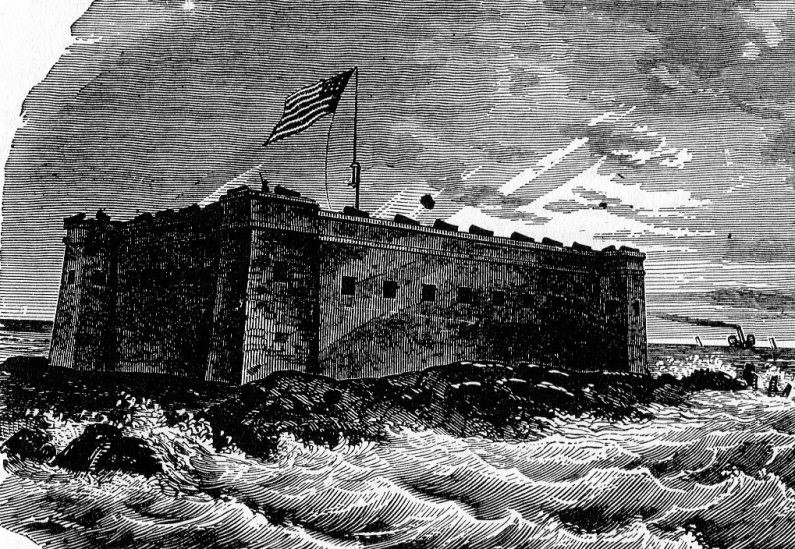
Fort Pickens (from Battles and Leaders)

The army garrison, at Barrancas Barracks, consisted of Company G, First Artillery, under the command of Lieutenant Adam J. Slemmer. The Navy Yard, with the steamers Wyandotte and Supply, a handful of marines and shore personnel, was under the command of Commodore James Armstrong.

Lieutenant Slemmer, seeing the political winds, had taken steps to ensure the government property in his charge, including gunpowder and many heavy cannon, did not fall into the hands of the secessionists. While Commodore Armstrong vacillated, Slemmer acted. On the 8th of January he had moved all the gunpowder from its exposed magazine and placed a regular guard on his facility.

These actions were immediately tested when a party of twenty civilians came with the apparent intent of occupying the barracks. The corporal of the guard raised the alarm and the civilians withdrew.  The next day Slemmer began the process of putting Fort Pickens in shape, making the living spaces habitable and mounting the cannon that made up its primary armament.

Although Armstrong promised the steamer Wyandotte to assist the army, it did not arrive. Slemmer and his men labored until midnight without any help from the navy. The next day, January 10th, Captain O. H. Berryman of the Wyandotte detached 30 seamen to help Slemmer, and the lieutenant moved all of the powder and all of the fixed ammunition for the field artillery under his command over to Fort Pickens.  That night he moved his men to the fort as well, spiking the guns at Barrancas since he had no means of moving them.

Although the Supply held provisions for Slemmer, she was not allowed to bring them to Fort Pickens on the 10th, only a small barge-full were offloaded. However, Slemmer convinced Armstrong to allow Wyandotte and Supply to dock at Pickens the 11th and managed to offload the much-needed provisions. He also acquired muskets and bayonets to arm the seamen still attached to his command.

On January 12, 1861 Armstrong surrendered the Pensacola Navy Yard to the State of Florida. Slemmer ordered what cannon he had mounted loaded with grape and canister and made what dispositions he could with a total garrison of only 81 men (44 artillerist privates, 4 artillerist NCOs, 31 seamen, 2 ordnance sergeants, a hospital steward, and Lieutenant Gilman, second-in-command). That afternoon a delegation led by Major Marks came to Fort Pickens and demanded its surrender. Slemmer refused.

Three days later, Colonel Chase, commanding the assembling Florida state troops, formally requested the surrender of Fort Pickens. Slemmer steadfastly refused. On the 18th Chase tried again. The Wyandotte and Captain Berryman still cruised nearby (Supply had sailed north on the 15th). Slemmer continued to deny Chase. With help from the Wyandotte, Slemmer even managed to mount a huge 10-inch Columbiad.

In a demonstration of how new the conflict was, once the status quo was clear, Chase allowed fresh provisions and mail to be delivered to Slemmer on a regular basis. Telegraphic exchanges with Washington were also allowed. The coming effusion of blood would soon render these amenities void for the rest of the conflict.

By February 5 Slemmer had mounted, by his report, no less than 54 cannon and had provisions and water for five months. He was opposed by almost 2,000 state troops but Chase had been unable to mount any heavy cannon to discomfit Slemmer. The next day the steamer Brooklyn arrived with reinforcements, ending any chance Chase had of taking the fort.

Lieutenant Adam J. Slemmer (from Battles and Leaders)

Slemmer’s sound judgment, quick action, and steadfastness had allowed the Union to retain the key position, essentially controlling the harbor of Pensacola. Fort Pickens would remain in Federal control for the war.

References:

Official Records of the Union and Confederate Armies, Series I, volume 1.

Gilman, J. H. “With Slemmer in Pensacola Harbor” in Battles and Leaders of the Civil War, vol. 1, Buel and Johnson, eds.

Lossing, Benson J. Pictorial Field Book of the Civil War, volume 1. Johns Hopkins University Press. Baltimore, MD, 1997 (reprint).

Saturday, January 24, 2015

Review - Savage Wars of Peace


In this well-referenced, clearly written survey of America's involvement in "small wars" from the Quasi-War with France in 1798 to Kosovo in 2001, Max Boot argues that America has a long history of involvement in other countries' internal affairs and that, up until Vietnam, the U. S. had a fairly decent track record.

American interventions often brought stability, security, and a large decrease in corruption while introducing health and infrastructure improvements. He also argues that economics, often touted as a primary reason for American involvement, has actually been generally of only secondary importance.

Boot lays out a clear, concise argument that America, if it leans on its historical experience, can and should be an agent of global security and state building. He cautions that if America does not listen to history, or if it opts out of its role, the consequences can be terrible - citing the Beirut bombing and the rise of Osama bin Laden as recent failures.

Although written in 2002 this book still has relevance in the tumultuous, jihadist-edged world. We still don't seem to understand the lessons of history though they are relatively easy to reference.

Recommended.

Thursday, March 6, 2014

On the Road to Muscle Shoals (Summer 1862 - fiction)


Brigadier General Harry T. Hays lay shivering under a heavy blanket even though the midsummer Alabama noon heat was causing a lethargy amongst his staff in the next room. It was all they could do to lift the glass of lemonade that the “girl”, Bessie, had brought them, from the table to their lips. General Hays had managed to catch a fever and had been shivering and miserable for the past three days. Fortunately, Union General Lovell Rousseau had been nowhere near, resting his division 30 miles to the west. Unfortunately, Major General Henry Halleck had ordered Rousseau to clear the Tennessee River of rebels east to Muscle Shoals the day before.

Rousseau, ever the reliable officer, had packed some extra cigars and a special bottle of cognac he had “borrowed” from an Alabama planter and set his blue-clad troops in motion. Hays had ordered entrenchments built before he had taken to his bed, but had not remembered about pickets or vedettes. His ranking brigadier, Robert Hoke, failed to order any scouts as well. General James R. Chalmers, commanding Hays’ other brigade, had just returned that morning from leave and was receiving reports over lunch about a mile away from where Hays was shivering.

 
Leading the Union advance was companies A and E, 1st Ohio Cavalry, all the mounted troops assigned to Rousseau. Early that July morning, Captain Morris, spied the Confederate works and reported back to Rousseau in person. The general, cigar in place, rode up to a small rise two miles from the Confederate lines.

Quickly assessing the situation, he summoned his three brigadiers, the taciturn regular Shepherd, the dapper lawyer John Starkweather, and the heavy-set former county sheriff, Samuel Beatty. Rousseau issued his orders in his slow, deep voice and bid his subordinates godspeed.


Beatty had only recently joined the division with a brigade of mostly untried recruits. Starkweather’s men at least had “seen the elephant” but were not nearly the “old hands” of Shepherd’s Regular Brigade. Rousseau’s plan depended heavily on the regulars (By God!). Hays would be badly outnumbered but his men were mostly veterans under seasoned regimental officers.

Starkweather opened the ball by bringing up in a powerful cloud of dust, Battery A of the Michigan Light Artillery. Their 6 10-pounder Parrots set up on the tallest hill in the area and began sending shells screaming 800 yards into the works held by the Confederate Guards Response Battalion of New Orleans. Starkweather brought his brigade up methodically, deploying two regiments in front of the battery and sending two more echeloning to the left to wrap around the end of the Confederate line.

Equally methodically, Beatty supervised his raw regiments in their approach. His brigade had the Union center and marched up along a farmer’s track, utilizing a fine wood lot to provide cover. His Kentucky light artillery deployed a full 45 minutes after Starkweather’s guns, their screening infantry having a little difficulty going through its drills under fire for the first time.


On the Union right, Shepherd’s regulars developed the attack swiftly with the Battery H, 5th United States Artillery supporting the 5 battalions who approached in open order, stretching around the Confederate left. The 1/18th and 2/18th combined with the guns to cut the 25th Alabama to pieces.

The situation on the Confederate left had rapidly become precarious as the disciplined and accurate fire from the regulars supported by the US Artillery and the Kentucky guns had already torn a hole in the line and threatened to break through the works and make the entire line untenable. Hoke had swiftly brought his two reserve regiments, the 7th Mississippi and 10th Mississippi, into position, the 10th on a cliff on the far left and the 7th behind the lines where the hapless 25th Alabama had just been eviscerated. However, he hesitated to leave the works.


It was at this moment that General Hays appeared, gaunt and white as a ghost but sitting tall on his sorrel gelding. Hays spoke softly to the much less experienced Hoke and the latter then sent a courier galloping to Colonel Simms of the 7th.

Simms was a newspaperman and a storyteller. Many a cold winter night he had regaled his regimental officers and other colonels with tall tales and embellished tales of the Indian Mutiny, actions in Afghanistan and expeditions into the darkest Africa (none of which places he had ever been, not that he let anyone know THAT particular fact).

Simms was, in addition to being a marvelous campfire one-man thespian, personally brave and quite desirous of having an actual personal adventure. Therefore, when the courier galloped up to him and said, “General Hoke’s compliments, Sir! He orders you, Sir, to push those people away!”

With a flourish the teller of tall tales embarked on his personal adventure. Placing his hat on the tip of his sword he thundered to the front of the regiment, bellowed, “Mississippians! Send the sowbellies back to Chicago! Forward, Seventh!”


Their charge was not the glorious one of the Napoleonic Age. No even, serried ranks with glittering bayonets and matching pom-poms. A ragged line of butternut burst over the hasty works, gathering momentum and losing cohesion, some of their ancient smoothbores lacking bayonets at all, most with tarnished, though sharp, blades. The blood-curdling rebel yell erupted from 400 throats and the open ordered 2/18th and 19th Battalions of US Regulars raced for the relative safety of Berger’s Knoll a mile to the rear.

The charge impetuously carried forward right past the Kentucky guns who poured canister into the tiring and scattering attackers. The 1/18th came to their brothers’ aid and finally, on the slopes of Berger’s Knoll, the three regular battalions turned on Simms and his now badly disorganized men. Simms would pen quite the tale for his newspaper, but from the “safety” of a Chicago prison, as he and 236 of his men surrendered.

Shepherd continued his attack with the 15th and 16th and the supporting US Artillery. Hoke’s howitzers scored a lucky hit on the Kentucky artillery as it attempted to reposition to reengage the 7th Mississippi after it had charged past. One shell hit a caisson and the ensuing explosion destroyed a battery wagon and stampeded a gun team that had just been limbered up. A second shell burst on the barrel of a Napoleon, killing 6 gunners.

However, it was a Pyhrric victory as the US Artillery landed Parrot bolts on two howitzers, disabling them and forcing young Lieutenant Dann to order the battery back. Without the guns the 21st Alabama and 5th Mississippi could not stand to the disciplined volley fire of the Regulars.


On the Union left, Starkweather and Beatty now pressed their attack, though their less experienced troops found it hard going against Chalmers’ veterans. After 30 minutes of fierce fighting though, with Hoke collapsing to his left, Chalmers ordered his brigade back as well.

Wheat’s Battalion had decimated the 21st Wisconsin but had in turn suffered almost 180 casualties. Chalmers’ guns engaged in a lopsided firefight where 55 gunners and almost every horse were shot down. A mere 23 men and a single Blakely rifle managed to pull back. The Confederate Guard Response Battalion, having rallied back, stopped a potentially devastating charge by the 15th Kentucky, preserving Chalmers’ ability to fight another day.

Hoke reformed with barely 700 men the next day; Chalmers had 1200. Rousseau was in complete control of the Tennessee River to Muscle Shoals.

Tuesday, December 3, 2013

The Ghosts of Antietam


The Ghosts of Antietam

I stand where the raw recruits of Colonel Dwight Morris stood over 150 years before. The wind gently brushes my salt and pepper hair and ripples the long expanse of grass slowly rising in front of me to the wagon road, known throughout history now as The Sunken Road. The sun bathes the entire expanse in bright warmth.

A cloud crosses over me, briefly slightly darkening my little patch and giving my skin a respite from the sun. Did I hear the jingle of a harness and a muffled word? I look left and right. Perhaps it was an exclamation from a couple further up on the interpretive trail I had so recently left.

I step forward with a slow measured step, much like the boys of the 108th New York, greeting the elephant for the first time that fateful September day. I swear the truck so far away sounds like the drums beaten by the tiny drummer boys. It must be my eyes playing tricks (I forgot my sunglasses at the hotel) but the grass ahead seems to be moving and puffs of white appear, almost like skirmish fire.

The illusion grows as I take each deliberate step up the gentle slope. I can’t ignore it or make it stop. Now I hear the jostling of men nearby, though I am alone, the clunk of wooden canteens on cartridge boxes, the swish of woolen uniforms through the tall timothy. There is a roar as I reach a point 400 yards from the sunken road. I feel an extra gust of wind pass by and hear a grunt, like the canister has found the range.

A twinge of uncertainty affects me, as the untried men so far from home must have felt to see the effect of those crude weapons for the first time. Do I go on, and brave the building illusion, or go back? Reach for the objective or run for safety?

I push on.

As I expected the illusion continues to grow, gain form, substance, sensation. My mind paints the outlines of men, so close, with every detail present but hazy unless I concentrate when it pops out in exquisite detail. An officer on horseback rides forward only to fall in the next blast of canister. Ahead, the gray-clad skirmishers fire and retire until they drop into the sunken road a scant hundred yards ahead of me. Then a leveled line of black musket muzzles steadies on the lowest rung of the fence bordering the road and an illusory ripple of red flame and white smoke pours all along the line.

I feel more than see my ghostly companions recoil in the effect of the imaginary volley. All around me the ephemeral forms litter the ground or clutch at wounds as they stagger forward and back. Another thunderous volley, accompanied by a further gust of wind, and my blue-clad companions have had enough. They recoil and head back from whence I started, some running, others walking backwards, still more stumbling numbly. And as they move they gradually disappear, leaving the fields again empty under the modern summer sky.

Antietam holds the ghosts for me, more than any other site, even Gettysburg. They are everywhere and need very little effort to conjure into consciousness. Both sides; all over the field. Burnside at his bridge, the veterans of the Stonewall Brigade as they rush to save the day. Hooker’s men and McLaws’ in the West Woods struggling in the morning mists. Even Porter’s veterans as they stood by, desperate to add the coup de gras but restrained by the cautious hand of McClellan.

They swirl restlessly by at times when I am far from the battlefield. They worry about being forgotten; lost in the sands of time. Not while I’m alive, anyway.

Tuesday, October 15, 2013

Romans Against the World (hypothetical)


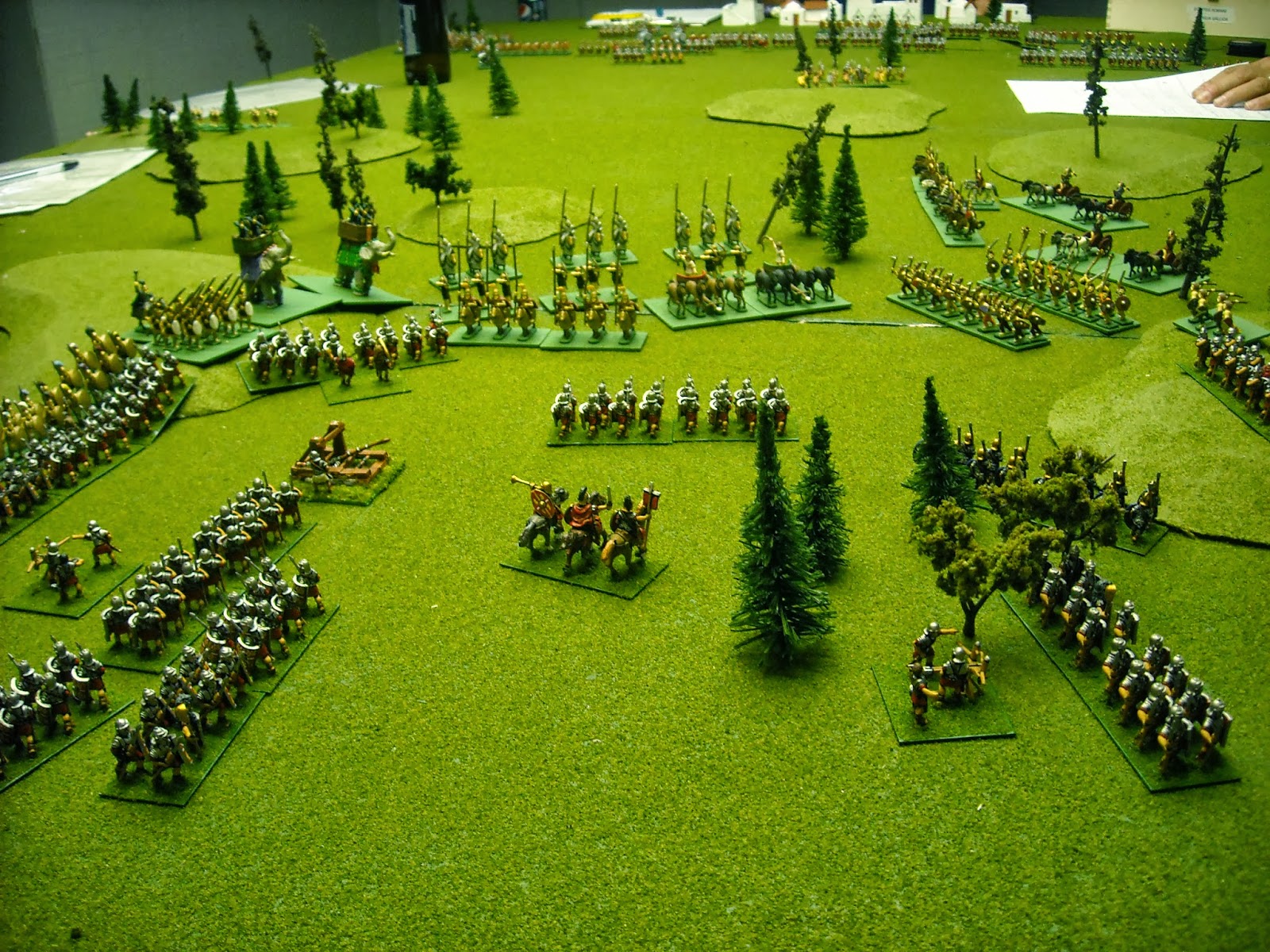
We play a set of Home Rules for Ancients. One of the guys in the club wrote the rules and painted the first 6 armies before we played a single game. They are relatively easy to play rules but they do capture the idea of all the different troop and weapon types of the long ancient period. Another member of the club recently raised two Roman legions, early Imperial. By a misunderstanding he raised them at about double strength of any of the original armies. One Friday in early October 2013 we decided to through a mess of troops, purely non-historical, at the two legions to see what mass would be necessary for an even fight. We didn't empty enough boxes!


The set-up was simple. One Roman legion (XX) would attack straight at a big Numidian army that was set up and defending a town. The second Roman legion (VIIII) was coming to support but would be surprised by an army of Helvetians/Gauls falling on one flank and a Persian army falling on the other.


This was the Numidians first time on the table. The battle went much as one would expect with the Roman heavy infantry inexorably pushing back the lighter but more numerous Africans. Unfortunately for the Numidians, their cavalry did not perform up to historical standards and were also pushed back.


Whereas the XX and the Numidians were battling over fairly even and clear terrain, the approaching VIIII Legion had some rough terrain to march through. It had the further complication of dual Consuls having been appointed to command and they were bickering over the distribution of the various ancillary units.


The (completely ahistorical) allies struck simultaneously from each side of the Roman relief column. Unfortunately for the attackers they were discovered far enough away from the column by scout dogs that the VIIII was able to deploy to meet the concentric attacks.


On the Roman right, the associated warbands of the Helvetian tribes struck. Their cavalry and chariots heading off the column, cutting them off from the city. Unfortunately for the alpine tribes, this left them overextended and they were meticulously pummeled by the Roman cohorts.


The Persians struck the Roman left and had better initial success. Their massive tower elephants pushed back a veteran cohort and their hoplites engaged in a stand-up slaughter with two more cohorts. However, there was just not enough weight to the Persian attack and it withered under the midday sun.


The end of the game found the relieving VIIII laagered comfortably, watching the Persians and Helvetians trail away while the smoke began to rise from the distant city.


One final, humorous anecdote. We have a single unit of hapless mercenaries which are often added to one army in our ancients games. This hapless unit is painted as Thracian medium infantry from the period of Alexander. It is understrength, having only 12 figures (most medium infantry being 16 or 18) and it is rated D class (one of very few to have this least desirable rating). In this game, however, they had their moment of glory as, unopposed, they marched up to a Roman battery of scorpions and charged!


If you enjoy this post, or any of the others here, please spread the word.

Friday, October 4, 2013

Early Spring 1777 - New Jersey (hypothetical)

 
Colonel Ebenezer Driscoll’s American brigade stomped out of their winter quarters in search of some rations and shoes. General Howe dispatched Brigadier Dirk Patch to spoil the American’s excursion and keep them hungry and barefoot.
The two columns met near Dricut’s Store on a cold sunny spring day.
Major Scudbucker had been stripping Farmer Northey of what was left of his larders when word arrived of the British advance. He sent a courier thundering (actually trotting, the horse was too lean to do much more) to Driscoll and called his men into formation. Captain Forrester’s Connecticut Light Infantry stretched out to cover the American south flank in an open wood lot. He then deployed his two companies of Pennsylvania Continentals behind fences and outbuildings on Northey’s farm supported by a section of 3-pounders. Scudbucker deployed his German Flats militia behind and in support of the guns.
Driscoll had personal control of the rest of his small command. He deployed his Connecticut Line to cover the American north flank in thick woods. The 5th Company of the 4th New York Line deployed on an open hill to the right of the Nutmeggers. His small detachment of riflemen moved to a copse of walnut trees between the hill and Northey’s farm. Coming up from the rear, where they had been “guarding” (more like looting) the already filled supply wagons, were the 3rd and 4th companies of the 4th New York.
 
Patch deployed his force in a long thin line opposite the Americans. Quickly the two forces were heavily engaged. The 42nd Highlanders led down the farmer’s trail with a 6-pounder lumbering by their side.  A slugging match ensued between them and the American riflemen on one side and the First Pennsylvania on the other.  The uneven struggle fixed the Americans’ attention to fatal consequences.
Major Jonathan Dimsdale led the 33rd Regiment of Foot sharply through the woods and into line in support of, and just north of, the Highlanders. From behind the Highlanders a company of Marines moved into the farm building opposite the Pennsylvanians and took up shooting positions under cover of the thick log walls. This, despite the New Yorkers deploying in support of the Pennsylvanians and delivering a measured volley.
 
The tide of battle, a battle only 15 minutes old, now turned distinctly in favor of the redcoats. While the Highlanders fell back the 33rd decimated the riflemen with rapid volleys, forcing them to likewise retire. On the far northern flank the dismounted 17th Light Dragoons started to drive the Connecticut lIne through the woods, though stubbornly opposed.
At the same time three companies of grenadiers approached Scudbucker’s center.  The Pennsylvanians did their best, standing stoically behind Northey’s fences but the balls arrived with much too great a regularity. One by one the Continentals fell out of line, dead, wounded, or just done in by the ferocity of the British fire. The cannons banged away but mostly ineffectually, getting only a single telling canister shot in that beheaded a poor lieutenant of the 23rd Foot and cut an entire section in half.
The coup de main in Scudbucker’s area was when the Grenadiers of the 5th Foot moved forward, bayonets glittering in the sunshine. The Americans had had enough.
On the far south flank the Light company of the 10th Foot methodically cut up the American Light Infantry and then chased away the militia, bravely led forward by Captain Van Eyken, with a deliberate fire by platoons.
With the riflemen and the Pennsylvanians falling back it was now the turn of the 5th New York company to be
decimated on their exposed position on the naked knob.
 
 
In apoplexy Driscoll watched his command melt away under the British fire. Captain Iverson’s company of New Yorkers and Miller’s Connecticut line, from cover of woods west of Northey’s farm, checked the British pursuit long enough for the remnants of the American brigade to slink away. All in all the Americans lost 211 men out of only 1120 engaged. Another 55 simply disappeared into the countryside, never to return to their units.  Patch’s regulars, by contrast, brought 1400 men to the fray and suffered a bare 96 men lost to all causes.
This battle was fought in 25mm in January 2013. We use A Continent in the Balance rules.